

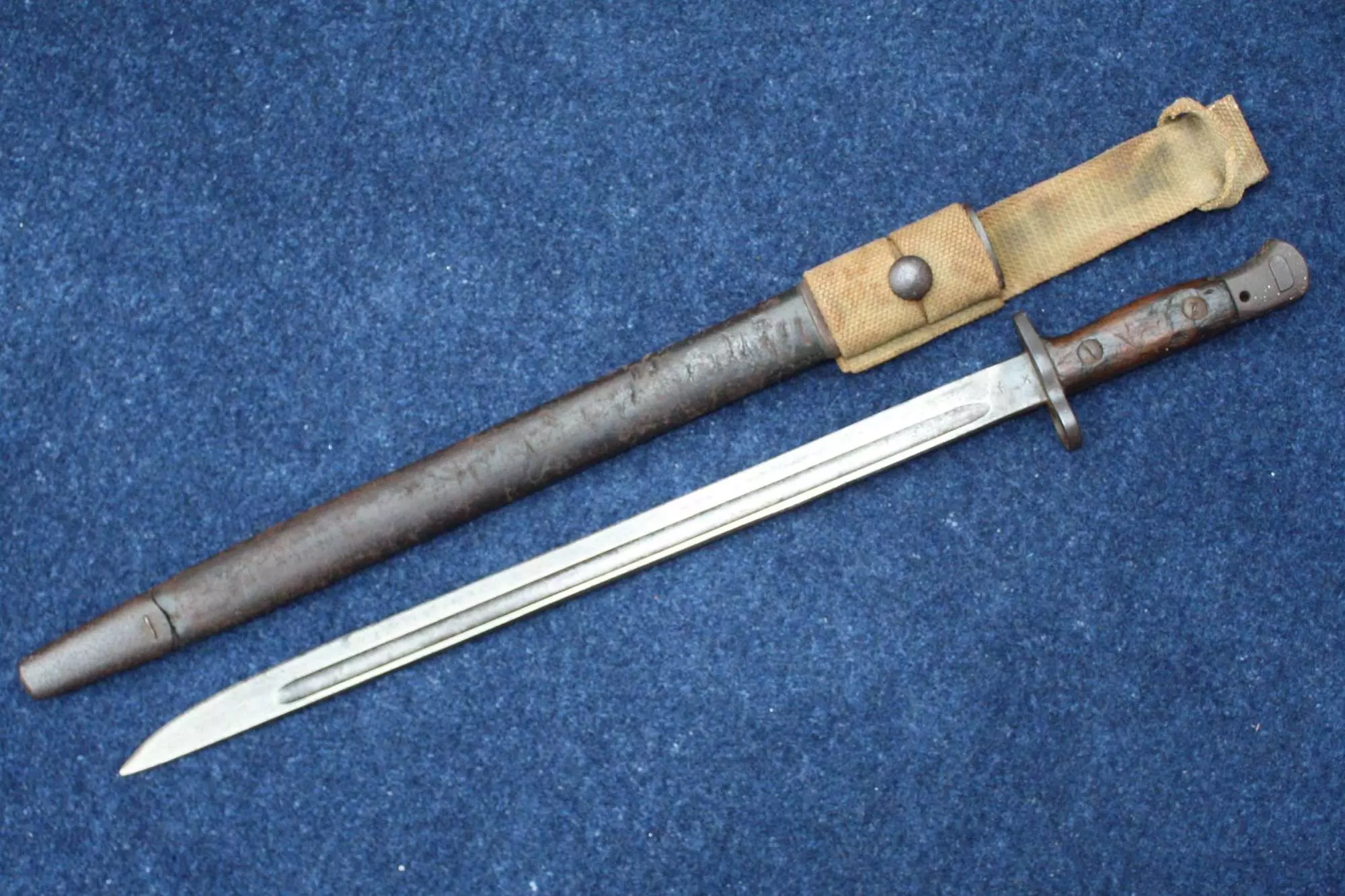
The British WWI bayonet is one of the most iconic weapons of World War I, symbolizing both the harsh realities of trench warfare and the ingenuity of military design. Unlike rifles or artillery, which dominated the battlefields from a distance, the bayonet brought soldiers into intimate and personal combat, combining the firearm with a sharp blade in one lethal package. Its role extended beyond mere utility; it became a psychological instrument, representing courage, fear, and the relentless intensity of close-quarters fighting.
Bayonets were issued to nearly every British infantry soldier during World War I, emphasizing their importance in trench warfare. They were not just secondary tools but essential equipment for survival when enemy lines clashed in confined, muddy trenches. Beyond combat, bayonets were also used for mundane tasks such as cutting wire, opening crates, or even cooking in desperate conditions, illustrating their multipurpose functionality.
This article delves into the fascinating world of the British WWI bayonet. From its historical origins to its intricate design, battlefield usage, and eventual status as a collector’s item, the bayonet reflects both technological innovation and human resilience. We will explore how this weapon shaped warfare, influenced military tactics, and continues to captivate historians and collectors alike.
History of the British WWI Bayonet
The history of the British WWI bayonet traces back to the late 19th and early 20th centuries, when militaries sought versatile tools that could complement the rifle. British designers adapted existing bayonet models to meet the harsh demands of modern warfare, particularly as trench warfare became widespread. The Pattern 1907 bayonet, one of the most recognized designs, emerged as a standard issue, optimized for durability, length, and ease of attachment to the Lee-Enfield rifle.
During World War I, manufacturers ramped up production to meet the needs of millions of soldiers. Companies like Wilkinson Sword and Sanderson were key players, producing bayonets in vast numbers. The industrialization of war meant that efficiency and uniformity were paramount, yet subtle variations existed depending on the manufacturer and production period. These historical nuances now help collectors identify the origin and authenticity of each bayonet.
The bayonet’s role evolved alongside battlefield tactics. Early war strategies relied heavily on bayonet charges, but as the conflict progressed and trench warfare dominated, the bayonet became a weapon of desperation and necessity. Soldiers often combined its use with close-range rifle fire, grenades, and improvised weapons. The historical significance of the bayonet, therefore, is twofold: it is both a testament to military strategy and a symbol of the personal courage demanded of infantrymen in grueling conditions.
Design and Types of British WWI Bayonets
The design of British WWI bayonets reflects a careful balance of practicality and lethality. Typically crafted from high-quality steel with hardwood grips, these bayonets were made to withstand rigorous use under extreme conditions. Their length ranged from 16 to 17 inches, making them effective for both stabbing and slashing. The attachment mechanism was designed to fit securely onto rifles, ensuring stability during combat maneuvers.
Different models were developed to suit evolving battlefield requirements. The Pattern 1907 was a long, sword-style bayonet, ideal for open-field combat, while shorter trench variants, like the Pattern 1913 and 1917, were optimized for confined spaces and close-quarters encounters. Some models incorporated multi-functional features such as wire-cutting notches or hooks, demonstrating early innovation in adaptable weaponry.
Functionality was central to the bayonet’s design. Soldiers relied on it not only for combat but also for survival tasks, including cutting branches, clearing obstacles, and even serving as makeshift cooking tools. This adaptability underscored the bayonet’s importance as a multi-purpose tool in the trenches. Each design iteration reflected battlefield feedback, illustrating how necessity shaped military innovation during one of the deadliest conflicts in history.
Usage on the Battlefield
The British WWI bayonet was a critical component of infantry training and strategy. Soldiers were rigorously trained in bayonet drills, learning both offensive and defensive techniques. The bayonet charge, while often romanticized, was a dangerous and physically demanding tactic, requiring precision, courage, and teamwork. Despite its fearsome reputation, actual use in combat was sometimes limited due to the prevalence of long-range artillery and machine guns.
Trench warfare presented unique challenges. Narrow, muddy tunnels left little room for movement, yet soldiers often found themselves in close encounters with enemy troops. In these scenarios, the bayonet became indispensable, combining the reach of a blade with the stability of a rifle. Its presence also had psychological effects; both the wielder and the opponent were acutely aware of the intimate danger it represented.
Accounts from veterans and historical records highlight both the utility and symbolism of the bayonet. Stories of bravery and desperation abound, with soldiers recounting moments where bayonets were their last line of defense. Even when not actively used in combat, the bayonet’s presence on a soldier’s belt reinforced a sense of preparedness and discipline, further embedding it into the culture of the British Army during WWI.
Collectible Value and Preservation Today

Today, the British WWI bayonet is highly sought after by collectors, historians, and museums. Factors such as rarity, manufacturer, condition, and provenance significantly influence its value. Authentic markings, engravings, or stamps from specific production years can make a bayonet exceptionally valuable. Models like the Pattern 1907 in excellent condition can fetch high prices among collectors due to their historical significance and craftsmanship.
Preserving a bayonet requires care. Collectors often focus on preventing rust, maintaining wood grips, and avoiding damage to the steel blade. Original scabbards and attachments enhance value and authenticity. Museums also prioritize proper display and conservation, ensuring these artifacts remain accessible for educational and historical purposes.
The bayonet’s status as a collector’s item highlights its enduring legacy. Beyond being a weapon, it is a tangible link to World War I, allowing modern audiences to connect with the experiences of soldiers who lived through the conflict. Each preserved bayonet tells a story, whether of battlefield valor, industrial craftsmanship, or historical remembrance.
Cultural and Historical Significance
The cultural and historical significance of the British WWI bayonet extends far beyond its practical use. Symbolically, it represents courage, endurance, and the harsh realities of trench warfare. It has been featured in literature, films, and historical documentaries, often illustrating the intimate, brutal nature of World War I combat.
In military traditions, the bayonet influenced tactics and weapon design for decades. Its combination of simplicity and effectiveness made it a cornerstone of infantry equipment and a symbol of preparedness. Even in modern ceremonial roles, bayonets remain part of drills and parades, serving as a reminder of the sacrifices and experiences of soldiers during WWI.
The legacy of the bayonet underscores the intersection of innovation and human experience. It is a historical artifact, a collector’s treasure, and a symbol of military heritage. By studying it, we gain insights into both the technological and cultural aspects of early 20th-century warfare.
Conclusion
The British WWI bayonet is far more than a simple weapon; it is a testament to military innovation, human endurance, and historical significance. From its design and battlefield use to its status as a collectible and cultural symbol, the bayonet embodies the essence of World War I. It reminds us of the courage and resilience required of soldiers and serves as a tangible connection to one of history’s most challenging periods. Preserving and studying these artifacts ensures that the lessons and legacies of the past remain alive for future generations.
FAQs
What is the most common British WWI bayonet model?
The Pattern 1907 bayonet is the most widely recognized and commonly found model.
How long were British WWI bayonets typically?
Most ranged between 16 to 17 inches, depending on the model and purpose.
Were bayonets widely used in actual combat during WWI?
Yes, especially in trench warfare and close-quarters combat, though artillery and machine guns often reduced opportunities for use.
How can collectors identify authentic WWI bayonets?
Authentic bayonets often bear manufacturer marks, production stamps, and model engravings. Condition and provenance also help verify authenticity.
What materials were used to make British WWI bayonets?
High-quality steel for blades and hardwood for grips were commonly used, sometimes with brass or metal fittings.
Are British WWI bayonets valuable to collectors today?
Yes, rarity, condition, and historical significance make them highly collectible.
Did all British soldiers carry bayonets during World War I?
Infantry soldiers were typically issued bayonets, while support units and specialized personnel might not have carried them.
You May Also Read: 4 Provinces Flag